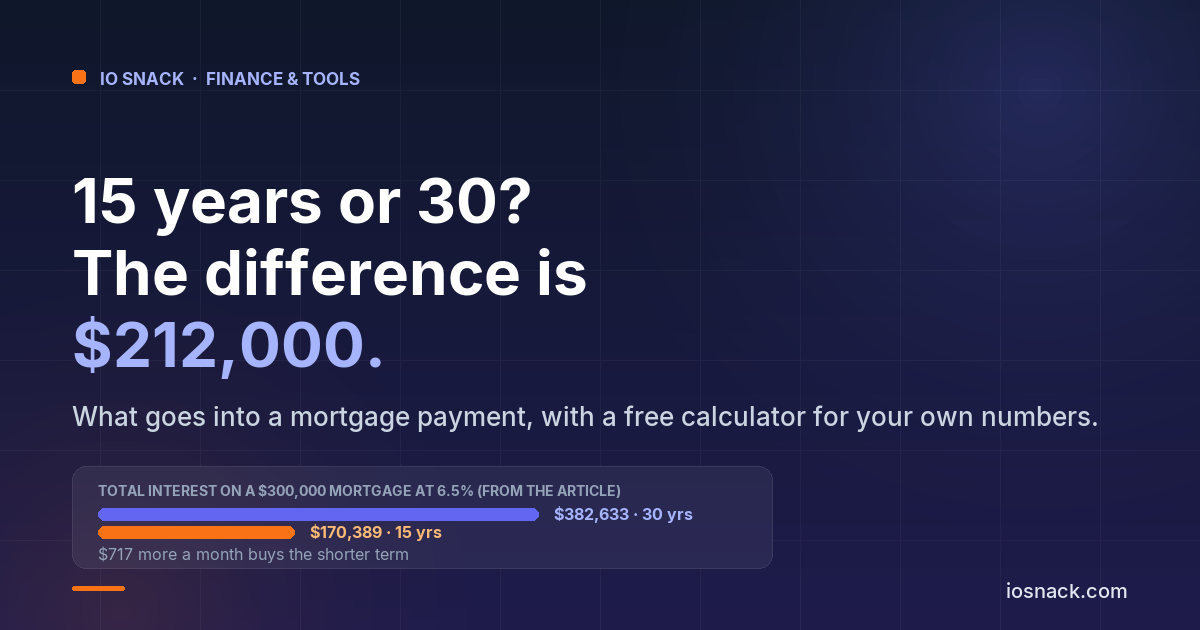
Taking out a loan? The term you choose affects your monthly payment AND total cost dramatically. A $25,000 auto loan at 7% for 3 years costs $4,800 less in interest than the same loan for 6 years. But the monthly payment is $380 higher. How do you find the right balance?
How EMI (Equated Monthly Installment) Works
EMI is a fixed monthly payment made to repay a loan within a set timeframe. Each EMI consists of two parts:
- Interest component — Higher in the early months, decreases over time
- Principal component — Lower in early months, increases over time
This means in the first year of a loan, most of your payment goes toward interest. By the final year, most goes toward principal.
The EMI Formula
EMI = P × r × (1+r)^n / [(1+r)^n – 1]
Where P = Principal, r = monthly interest rate, n = total months.
Skip the math — use our free Loan Calculator to instantly compare different terms and rates.
Real Comparison: $25,000 Auto Loan at 7%
3-Year Term
- Monthly EMI: $772
- Total Interest: $2,782
- Total Cost: $27,782
5-Year Term
- Monthly EMI: $495
- Total Interest: $4,700
- Total Cost: $29,700
7-Year Term
- Monthly EMI: $378
- Total Interest: $6,741
- Total Cost: $31,741
The 7-year term has the lowest monthly payment but costs $3,959 more in interest than the 3-year term.
How to Choose the Right Loan Term
- Calculate your budget — What monthly payment can you comfortably afford after all expenses?
- Compare total costs — Use our Loan Calculator's comparison feature to see two loans side-by-side
- Consider the asset — Don't finance a car for longer than you plan to keep it
- Factor in opportunity cost — Could the money saved on a lower payment earn more if invested?
- Plan for extra payments — Take a longer term for lower required payments, then make extra payments when you can
The Extra Payment Strategy
Here's a smart approach: Take the longer loan term (lower required payments), but make extra payments whenever possible. This gives you flexibility — if money is tight one month, you can skip the extra. If you get a bonus, put it toward the principal.
Example: Take the 5-year term ($495/month) but pay $772/month (the 3-year amount). You get the security of a lower required payment with the savings of a shorter payoff.
Try our Extra Payment Calculator to see exactly how much you'd save.
Types of Loans and Typical Rates (2026)
- Personal Loans: 6-15% depending on credit score
- Auto Loans: 4-9% for new cars, 5-12% for used
- Student Loans: 4-8% federal, 5-15% private
- Business Loans: 6-20% depending on type and risk
- Home Equity Loans: 7-10%
Tips to Get a Lower Interest Rate
- Improve your credit score before applying — even 50 points can save thousands
- Shop around — compare at least 3-5 lenders
- Consider a secured loan — collateral typically means lower rates
- Negotiate — especially with your existing bank
- Look into credit unions — often offer better rates than traditional banks
Calculate Your Loan Now
Our free Loan Calculator lets you compare different terms side-by-side, calculate extra payment savings, and see the full amortization schedule. Make an informed decision before you borrow.
Every dollar saved on interest is a dollar earned. Calculate your loan now →