ChatGPT, Claude or Gemini? It is the question every business owner asks once the free version stops being enough, and most answers online are a year out of date or written for American readers paying in dollars. This guide uses the prices each company shows a visitor in Pakistan today, independent test scores rather than the companies' own claims, and what we have learned from building on all three. By the end you will know what each plan costs in rupees, which one is actually smartest, why the cheapest price per word is often not the cheapest bill, and which one we would pay for at each size of business.
The Short Answer
If you only read one section, read this one. All prices were checked on 26 September 2026.
- For one person who mostly writes, plans and answers email: ChatGPT Plus (Rs 5,700 a month) or Google AI Pro (Rs 5,600 a month). Both are priced in rupees. Pick Google if your business already runs on Gmail and Google Docs, ChatGPT if it does not.
- For the hardest thinking work, long documents and careful writing: Claude Pro ($20 a month). On the independent scores below, Claude's top model is currently the smartest of the three.
- For a team of 2 or more: a business plan, not personal ones. ChatGPT Business and Claude Team both say they do not train on your business data by default. That alone is worth the switch.
- If you are building AI into your own product: do not choose on price per token. Choose on cost per finished job, which we explain below.
What Each Plan Costs in Pakistan
OpenAI and Google now show prices in rupees to visitors from Pakistan. Anthropic still shows Claude in US dollars, so you pay in dollars on your card, plus whatever your bank charges for the conversion. These are the prices each company's own pricing page showed us, before tax:
| Tier | ChatGPT (OpenAI) | Gemini (Google) | Claude (Anthropic) |
|---|---|---|---|
| Free | Rs 0 | Rs 0 | $0 |
| Entry | Go: Rs 1,400 a month (may include ads) | AI Plus: Rs 1,400 a month | No entry tier |
| Main paid plan | Plus: Rs 5,700 a month | AI Pro: Rs 5,600 a month (includes 5 TB storage and YouTube Premium Lite) | Pro: $20 a month, or $17 a month paid yearly ($200 up front) |
| Heavy user | Pro: from Rs 27,999 a month | AI Ultra: from Rs 21,999 a month | Max: from $100 a month |
| Business, per seat | Business: Rs 5,600 a month paid yearly, Rs 7,000 monthly (2 to 200 people) | Not shown on Google's consumer pricing page | Team: $20 a month paid yearly, $25 monthly (2 to 150 people) |
Two things stand out. First, the main plans from OpenAI and Google now cost almost exactly the same in Pakistan, Rs 5,700 against Rs 5,600, so the choice between them is about fit, not price. Second, Google's AI Pro bundles 5 TB of cloud storage. If you already pay Google for storage, the AI part is close to free.
Which One Is Actually Smartest? The Independent Scores
Every company publishes tests that show its own model winning. We do not use those to compare. Artificial Analysis, an independent company that runs the same set of tests on every model, publishes an Intelligence Index and what it cost to run each model through its tests. Here are the flagship and budget models from all three, each at its "high" effort setting, as listed on 26 September:
What this tells a business owner:
- Claude is on top right now. Opus 5.5, released on 22 September, leads the independent index at every effort level we looked at. OpenAI's best model, GPT-6 Astra, is close behind.
- Google has no current flagship in this race. Google's newest model, Gemini 3.8 Flash, is a fast mid-range model. It is by far the quickest of the group, at about 330 tokens (pieces of words) a second against 57 to 135 for the others, which matters for chat and voice. But on raw thinking it sits behind GPT-6 Sol. Google DeepMind's head, Koray Kavukcuoglu, said at a conference this week that Gemini 4 is in its final training stage and should arrive well before the end of the year, so expect this to change.
- GPT-6 Luna is the bargain. It scores the same as Claude Sonnet 5 at about one sixtieth of the cost per task. For simple, high-volume work such as sorting emails or tagging invoices, that gap is the whole business case.
Do not pick an AI by its price per word. Pick it by what one finished job costs, because the model that uses fewer words to get there is often the cheaper one.
Price Per Word Is Not Price Per Job
If you or your developer are building AI into your own software, you pay per token, roughly per word. Here are the list prices on each company's own API pricing page, per million tokens, for standard use:
| Model | Input | Output | Independent cost per task |
|---|---|---|---|
| Claude Opus 5.5 | $4.00 | $20.00 | $1.82 |
| GPT-6 Astra | $10.00 | $50.00 | $1.73 |
| GPT-6 Sol | $2.00 | $10.00 | $0.37 |
| Gemini 3.8 Flash | $0.75 (rises to $1.50 on 1 Jan 2027) | $3.75 (rises to $7.50) | $1.24 |
| Claude Sonnet 5 | $2.00 | $10.00 | $1.79 |
| GPT-6 Luna | $0.10 | $0.50 | $0.03 |
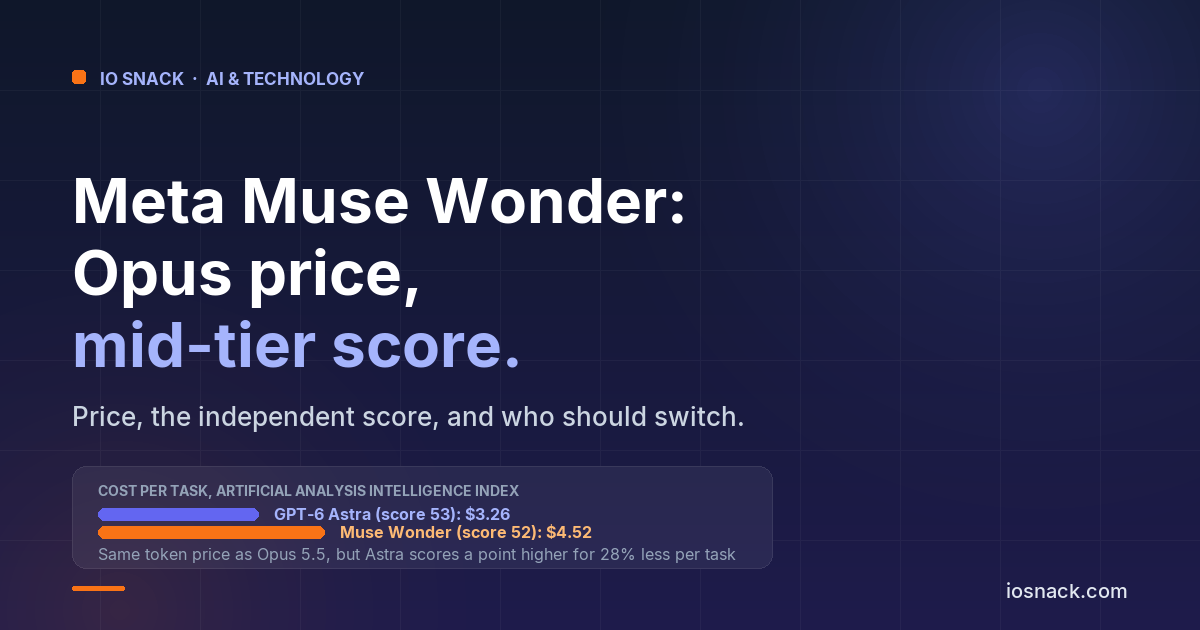
Look at two rows. Gemini 3.8 Flash is the cheapest per token of the mid-range models, at less than half the price of GPT-6 Sol. Yet in the independent tests, a task on Gemini 3.8 Flash cost about three times as much as the same task on Sol. The only way that happens is if Flash uses far more tokens, mostly in hidden "thinking", to reach its answer. The same pattern shows at the top: GPT-6 Astra costs two and a half times as much per token as Claude Opus 5.5, but the two came out at almost the same cost per task.
This is the single most common mistake we see when businesses choose a model. A price list tells you the rate. It does not tell you how many units the job will take. Before you commit, run 50 of your own real tasks through two or three models and compare the bill, not the rate card. We covered the other half of this problem, prices that change after you have built on them, in our guide to AI API price rises coming in 2027.
What Each One Is Best At for Everyday Business Work
Scores are averages. In daily use each assistant has a personality and an ecosystem, and for most businesses that matters more than a few index points.
ChatGPT: the widest toolkit
- Works with the tools you already use. OpenAI lists extensions for Excel, Word, PowerPoint and Google Sheets, plus scheduled tasks, projects and custom GPTs on Plus.
- A real free and budget tier. Free users get unlimited text chats on GPT-5.6 Luna, and Go at Rs 1,400 adds more uploads, images and voice, though OpenAI says it may include ads.
- Best for: the general office assistant, marketing drafts, voice chat and a team that wants one tool for everything.
Claude: the careful thinker
- Top of the independent index. Opus 5.5 is included in Pro, and Anthropic says it follows the writing rules you give it closely.
- Built for long work. Pro includes Claude Code, Claude Design, Slides and Docs, and Claude inside Chrome and Microsoft 365.
- Best for: contracts, reports, analysing long documents, software work and anything where a wrong answer is expensive. The catch is price in dollars and no cheap entry plan.
Gemini: the Google Workspace choice
- Lives inside Gmail and Docs. Google AI Plus and Pro put Gemini directly inside Gmail and other Google apps, and Pro adds Docs.
- The best bundle. AI Pro includes 5 TB of storage, and Google also includes video creation credits in its Flow studio.
- Best for: businesses already on Google Workspace, and anyone who needs fast answers more than deep ones. Wait for Gemini 4 before judging Google on hard reasoning.
The Privacy Setting Most People Never Check
On personal plans, your chats can be used to improve the models unless you switch it off. OpenAI's own pricing table says "Content is used to train our models" on Free, Go, Plus and Pro, with an opt-out available. Anthropic lists model training as "Opt-out" on its personal plans. On Google's developer API, the free tier is marked as used to improve Google's products, and the paid tier is not.
The business plans flip the default. ChatGPT Business says "No training on your business data by default", and Claude Team says the same about your content. If your staff paste customer details, invoices or contracts into an AI tool, this is the strongest reason to pay for a business plan rather than let everyone use their own. Our guide to who can read your ChatGPT conversations walks through the exact settings.
Our Pick by Size of Business
- Solo owner or freelancer: start with the free tier of all three for a week on your real work. Then pay for one. ChatGPT Plus or Google AI Pro if you want rupee billing, Claude Pro if your work is heavy on documents or code.
- Team of 2 to 20: ChatGPT Business at Rs 5,600 a seat on a yearly plan, or Claude Team at $20 a seat. You get central billing, shared projects and, most importantly, no training on your data by default.
- Building AI into your own product: test cost per job, not price per token. For simple, high-volume tasks, GPT-6 Luna is hard to beat today. For hard tasks where accuracy matters, Claude Opus 5.5 or GPT-6 Sol. Plan for a switch, because the leader changes every few months.
One more opinion: do not lock your business to one vendor. Five of the six models in the chart above were released this month, and the order will change again when Gemini 4 arrives. The businesses that save the most are the ones that can move a task to whichever model is best value that month.
Your Next Step
If you want the details on Claude's newest model and what it really saves, read our breakdown of Claude Opus 5.5 pricing. If you would rather not choose at all, our AI Chat Assistant runs on more than one AI engine with built-in redundancy, so your customer chat keeps working whichever company is ahead this month. And if you are building AI into your own business and want help picking the model that gives the lowest cost per finished job, talk to us. We will test it on your real work before you spend on it.