Meta released Muse Spark Open on 15 October: an 816-billion-parameter model whose weights you can download, run on your own hardware and build into your product for free. Meta calls it the most capable American open-weight model so far. The first independent test from Artificial Analysis gives it a score of 39 and a cost of $0.84 per task, which puts it behind several open models you can already use, and behind GPT-6.1 Sol on both counts. This article covers what Meta shipped, what it costs to call, what it takes to run yourself, what the licence actually says, and who should bother.
What Meta released on 15 October
Everything below is from Meta's model card and licence on Hugging Face, unless we say otherwise.
- The model. 816 billion parameters in total, of which 42 billion are active for each token. It is a mixture-of-experts design: 256 experts, 8 used per token, 62 layers.
- What goes in and out. Text, images, video and audio go in, text comes out. The context window is 1 million tokens.
- What Meta built it for. Coding, agents that use tools over many steps, and reading screenshots, charts and documents. Meta also lists generating training data and grading other models' answers.
- Two downloads. A full-precision BF16 version and a compressed NVFP4 version.
- A separate safety pass. Meta says this open version got extra safety training, because once you download it there is no Meta system sitting in front of it to block misuse.
- A gate on the download. Before Hugging Face gives you the files, Meta asks for your full legal name, date of birth and your organisation's full name with its corporate identifiers.
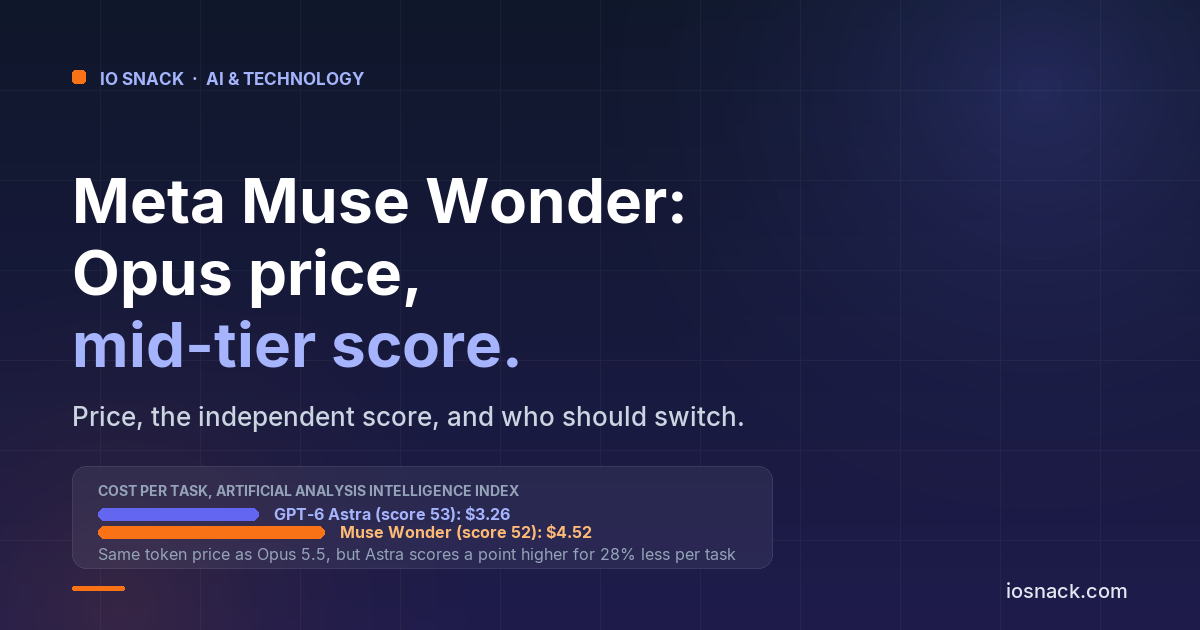
This is a different product from Muse Wonder, the closed model Meta released three days earlier at $4 in and $20 out per million tokens, which we covered in Meta Muse Wonder: price and benchmarks. Wonder is Meta's best model and you can only rent it. Spark Open is a smaller sibling you can own.
What it costs to call through an API
Meta does not sell Spark Open through its own API. You rent it from inference companies that host it. Artificial Analysis lists five, and the ones that publish a price all charge the same:
| Host | Input / 1M tokens | Output / 1M tokens | Speed (tokens/s) |
|---|---|---|---|
| Makora (NVFP4) | not listed | not listed | 489.7 |
| Baseten | $1.25 | $4.25 | 242.4 |
| Nebius (FP4) | $1.25 | $4.25 | 110.5 |
| Together AI | not listed | not listed | 98.7 |
| Fireworks | $1.25 | $4.25 | 89.7 |
Prices and speeds as listed by Artificial Analysis on 21 October 2026. The same model runs five times faster on the quickest host than on the slowest, at the same price. If you are building a live chat or a voice agent, that gap matters more than any benchmark below.
Artificial Analysis rates $1.25 in and $4.25 out as "expensive" for a model of this kind, where the typical price is $0.43 in and $1.68 out. That is the first hint of where this is going.
The independent score: 39, at $0.84 per task
Price per token tells you little on its own. A cheap model that writes three times as much, or needs three attempts, ends up costing more. That is why we compare models on cost per task: what Artificial Analysis actually spent, on average, for each task in its Intelligence Index, a set of ten tests of reasoning, coding, agent work and office tasks.
Muse Spark Open scores 39 and costs $0.84 per task. It is also fairly concise: it produced 110 million tokens across the whole index, against a typical 140 million. Here is how that sits against the open models it competes with, plus one closed model for reference:
Read the chart in plain money. A thousand tasks cost about $840 on Muse Spark Open and about $260 on DeepSeek V4.1 Flash, which scores six points higher. GPT-6.1 Sol, a closed model, scores thirteen points higher and still costs less per task. Spark Open is cheaper than Kimi K3 and GLM-5.3, but both of those score five or six points higher.
So if all you want is the most capability per dollar through an API, Muse Spark Open is not the answer today. Its case has to be made on other grounds, and it has some.
Where Meta's own benchmarks say it wins
Meta's model card compares Spark Open with seven other open models. These are Meta's numbers, run by Meta, and should be read that way. They do show a pattern worth knowing:
- Agent work. On JobBench, a test of completing real job tasks, Meta reports 61.8, ahead of every model in its table, including GLM 5.3 at 61.4. On MCP-Atlas, which tests using tools through the MCP standard, it reports 89.2, the highest in the table.
- Operating a computer. On OSWorld Verified, where the model drives a real desktop, Meta reports 80.4. Of the models Meta shows a score for, only Kimi K3 is higher, at 84.8.
- Seeing. On the image and video tests Meta ran, Spark Open beats Kimi K3 on three of six, including ZeroBench (50.0 vs 41.0), and loses on the other three, including video (61.5 vs 65.4).
- Refusing misuse. On StrongREJECT, where lower means harder to trick into harmful output, Meta reports 0.5 for Spark Open and between 62.9 and 86.4 for the other models it tested.
- Where it loses. Coding. On Terminal-Bench 2.1, Kimi K3 scores 85.0 to Spark Open's 76.4, and on DeepSWE Spark Open's 60 trails GLM 5.3 and Kimi K3 at 67 and 68.
That fits Meta's description: an agent model that can see and hear, built to be hard to misuse. It does not fit "best open model", and Meta's own first row, the Artificial Analysis score, shows three models in its own table ahead of it.
Muse Spark Open is not the smartest or the cheapest open model you can rent. Its real case is that you can own it, it can see and hear, and it is very hard to turn against you, and only some businesses need all three.
Running it yourself: what 700GB of memory means
The reason to choose an open model over a rented one is control. Your data never leaves your own machines, nobody can change or withdraw the model under you, and there is no per-token bill. That is the same reason our AI Cam runs its detection on a device on your own premises and keeps footage in the building.
The catch with Spark Open is size. According to Meta's model card:
- Compressed (NVFP4). At least 700GB of GPU memory. That is more than eight 80GB data-centre cards hold between them.
- Full precision (BF16). About 2TB of GPU memory.
- The Mac route. Meta says it is optimised to run on two Mac Studios with Apple's M5 Ultra chip, using Apple's MLX software. That is the cheapest way to hold it on a desk, but it is still two top-specification workstations for one model.
- Software. Meta lists SGLang, vLLM, Hugging Face, TensorRT-LLM, Unsloth and Llama.cpp as supported.
For a typical small business, that is not a weekend project. From running AI in production, our view is that a model this size only pays for itself when it is busy most of the day. A server that sits idle overnight still costs the same. Below that volume, renting from a host at $1.25 and $4.25 per million tokens is far cheaper than owning, and if you are renting anyway, the chart above says there are better-value models to rent.
Where owning does make sense: a company with strict data rules and steady volume, a software firm building a product on top of it, or a group that needs a model it can fine-tune on its own documents and keep.
The licence, in plain English
The Muse Model License is short. Read it yourself before you build on it, but here is what it says:
- Free, including for commercial use. You may use, copy, modify, fine-tune, distil, merge, publish, distribute and sell copies, subject to the conditions below.
- Attribution. Any product built with it, or with a model trained from it, must show "Built with Muse Spark Open" in the interface, the documentation, the website or a settings menu.
- The $20 million clause. If you sell access to AI models to other companies through an API, and your group's revenue is above $20 million in any 12-month period, you must tell Meta and sign a separate agreement first. This does not apply to internal use, or to using the model to power features of your own product. Almost no business reading this will hit it.
- Outputs are yours. Meta claims no ownership of what the model generates.
- No warranty. If a fine-tuned version you make misbehaves, Meta takes no responsibility.
Two lines in the attached usage policy matter for ordinary businesses. You may not use it to practise a regulated profession without a licence, which names financial, legal and medical work, and you may not use it to infer private details about people, such as health or identity, without the legal right to. The model is also not meant for anyone under 18.
For comparison, Artificial Analysis lists DeepSeek V4.1 Flash and MiMo-V2.6-Pro under the MIT licence, which has no attribution rule and no revenue clause. Spark Open's licence is reasonable, but it is not the most permissive on the chart.
Who should use it, and who should wait
- Teams building agents that read screens, documents or video. Worth a real trial. Meta's agent and vision numbers are strong, and its refusal results suggest it is harder for a hostile user to talk round. Test it on your own tasks before you believe any of this.
- Companies that must keep data on their own machines and have the volume. It is a serious candidate, especially if your buyers ask where your models come from. Price the hardware before the project, not after.
- Anyone choosing a model by price through an API. Look at DeepSeek V4.1 Flash or MiMo-V2.6-Pro first, or GPT-6.1 Sol if a closed model is acceptable. Each does more for less per task.
- Urdu and Arabic users. Meta says the model was trained on data in more than 100 languages, but also that it has not been evaluated on all of them and may be weaker outside the strongly supported set. Meta's Hugging Face page lists English. Test your own language before you commit.
- Small businesses buying a finished tool. Do not choose by model name at all. Choose by what the product does for you and what it costs per month.
What we would do this week
If you already pay for AI through an API, spend an hour running twenty of your real requests through Muse Spark Open on one of the hosts above, next to the model you use now. Compare the answers and the bill, not the headlines. If your work involves screenshots, scanned documents or video, include those, because that is where Meta claims its edge.
If you are weighing open models more broadly, our guide to when an open-weight model is the right call walks through the cost per job and the hidden catches, and our Mistral Large 4 review covers the European option, whose weights Mistral has promised but not yet released.
And if you would rather not run any of this yourself, our AI Chat Assistant and AI Cam pick and manage the models for you. Talk to us about what you need it to do, and we will tell you honestly whether an open model belongs in it.