Alibaba released Qwen4-Max on 16 November, and on a price list it looks like a bargain: $1.50 per million input tokens and $4.50 per million output tokens, with a million-token context window. That is the same input price as Google's Gemini 4 Hydrogen and 40% less on output. But a price per token is not what you pay for. You pay for finished jobs. On the independent Artificial Analysis test, Qwen4-Max scores 43 and costs $3.27 a task, which is more than Hydrogen, more than three times GPT-6.2 Sol, and it takes 27 minutes a task to get there. This article sets out what Alibaba launched, what the independent numbers say, and who should still consider it.
What Alibaba released on 16 November
The facts below come from Alibaba's own press release and its Model Studio model page, both read on 22 November.
- The model. Qwen4-Max is the first model of the Qwen4 family and, in Alibaba's words, the most capable Qwen model so far. Alibaba says it has 2.4 trillion total parameters and uses about 71 billion of them per token.
- Model id.
qwen4-maxon Alibaba Cloud Model Studio. It is also on QwenCloud through the Token Plan, and inside Alibaba's own apps. - What goes in and out. Text, images and video in; text out. The context window is 1,000,000 tokens, and a single answer can run to 131,072 tokens, or 262,144 in thinking mode.
- Features. Web search, function calling, parallel tool calls, structured JSON output, prompt caching and batch inference are all listed as supported.
- Plug-in compatibility. The model page lists the OpenAI Chat Completions, OpenAI Responses and Anthropic Messages formats as supported. In plain terms, if your software already talks to OpenAI or Claude, trying Qwen4-Max can be close to a change of address and model name.
- What it is not. There are no open weights for Qwen4-Max, and the model page lists fine-tuning and private deployment as not supported. Alibaba says smaller open-weight Qwen4 models will come later.
The price: $1.50 in, $4.50 out, and a small free quota
These are the international (Singapore) prices from the Model Studio page, per million tokens, read on 22 November.
- Input. $1.50, flat across the whole 1M-token window, in both thinking and non-thinking mode.
- Output. $4.50. Thinking tokens are part of the output, so a model that thinks a lot pays this rate on its thinking too.
- Cached input. $0.075, which is a 95% discount on repeated input such as a long system prompt or a reference document.
- Free quota. 1 million tokens, valid for 90 days from when you activate Model Studio or from the model's release, whichever is later. That is enough for a fair trial, not for running a business.
Alibaba also claims, on its own Work360 benchmark, that Qwen4-Max uses 35% fewer tokens than Qwen3.8-Max at High effort and cuts the average cost per task by around 60%. Work360 is Alibaba's proprietary test, so that is Alibaba's number, not an independent one. The independent test below tells a different story about how many tokens this model uses.
What the independent test says: 43 points, $3.27 a task
Artificial Analysis runs every model through the same set of nine tests (its Intelligence Index, version 5.0.1) and publishes the score, the time and the money each one took. We read its pages on 22 November. Qwen4-Max was run at xhigh, its top thinking setting; the other models are shown at the setting Artificial Analysis lists for them.
| Model | Input / output price | Index score | Cost per task | Minutes per task |
|---|---|---|---|---|
| GPT-6.2 Sol (Max) | $2 / $10 | 57 | $1.01 | 10.1 |
| Gemini 4 Hydrogen (xhigh) | $1.50 / $7.50 | 54 | $3.16 | 16.9 |
| GPT-6.1 Terra (Max) | $1 / $5 | 51 | $0.96 | 15.3 |
| Qwen4-Max (xhigh) | $1.50 / $4.50 | 43 | $3.27 | 27.0 |
| DeepSeek V4.1 Flash (Max) | $0.30 / $1.20 peak | 33 | $0.60 | 14.4 |
Token prices come from each vendor's own page (Alibaba, Google, OpenAI and DeepSeek), read on 22 November. DeepSeek charges half price outside its peak hours; the peak price is shown.
On the Artificial Analysis page, Qwen4-Max ranks 51st of 95 models on intelligence, just under the median score of 44 for comparable models. Its own summary calls the model below average in intelligence but well priced, notably slow and very verbose. Those last two words are the whole story.
Qwen4-Max is cheap per token and expensive per job, because it writes about twice as much as a typical model to reach an answer.
Why a cheap token turns into a dear job
The cost of a task is the price per token multiplied by the number of tokens the model uses. Qwen4-Max wins the first half and loses the second.
- It writes a lot. To finish the test, Qwen4-Max produced 127 million output tokens. The median for comparable models is 65.4 million. So it wrote about 1.9 times as much as a typical model, and every one of those tokens is billed at the output rate.
- The output discount does not cover it. Against Gemini 4 Hydrogen, Qwen4-Max is 40% cheaper per output token ($4.50 against $7.50) and has the same input price. Yet per finished task it costs slightly more ($3.27 against $3.16) and scores 11 points lower.
- The dearer-looking models are cheaper. GPT-6.2 Sol charges $10 per million output tokens, more than twice Qwen4-Max, and still finishes a task for $1.01. That is about a third of Qwen4-Max's cost per task, with a score 14 points higher. GPT-6.1 Terra does it for $0.96 at a score of 51.
This is the same pattern we described in our article on the cheapest AI model for a business: the price list tells you the rate, not the bill. A model that thinks for longer on every request can cost more than a model with a higher sticker price.
One caveat that works in Qwen4-Max's favour. Artificial Analysis tested it at xhigh, its most thorough setting. Alibaba's model page says the default is high, and a low setting exists too. A lower setting should use fewer tokens and cost less per request, but nobody has published independent numbers for Qwen4-Max at those settings yet, so that is our expectation, not a measured result. Alibaba's own 35% token saving was measured at High.
Speed: two minutes before the first word
For many businesses, speed matters as much as cost. The Artificial Analysis figures for Qwen4-Max, read on 22 November:
- Time per test task. 27.0 minutes, against a median of 12.6 minutes for comparable models. That is more than twice as long.
- Wait for the first answer token. 120 seconds on average, because the model thinks before it answers. GPT-6.2 Sol's figure is about 84 seconds and Gemini 4 Hydrogen's about 55.
- Output speed. 65 tokens a second once it starts writing.
These are numbers from a hard test at the top thinking setting, not from a short customer question. But they point in a clear direction. From building chat and voice products, our view is that a customer on WhatsApp or on a phone line will not wait two minutes for a reply. For anything a customer sees live, Qwen4-Max at a high thinking setting is the wrong tool. It fits work that runs in the background: overnight document review, long reports, batch jobs where nobody is waiting.
Where Qwen4-Max still makes sense
None of this makes it a bad model. It makes it a specialist. There are honest reasons to try it.
- Very long inputs with heavy reuse. A 1M-token window at a flat $1.50, with cached input at $0.075, suits jobs that send the same large document or code base again and again and ask for short answers. When the output is short, its verbosity hurts less.
- Video and image understanding. Qwen4-Max takes video as input. If you need to read product videos or recorded walkthroughs and a text summary is the output, it is one of the options to test.
- Supplier spread. Some businesses want a second or third supplier so that one outage or one price change does not stop them. Because Qwen4-Max speaks the OpenAI and Anthropic formats, it is cheap to keep as a fallback.
- Chinese-language work. Qwen models are built in China and are a natural candidate for Chinese text. We have not tested that ourselves, so treat it as a reason to run your own test, not as a finding.
Before you switch: the checks for a Pakistan or Gulf business
- Where your data goes. The Model Studio page lists six regions for this model: China (Beijing), Singapore, Germany (Frankfurt), the United States (Virginia), Japan (Tokyo) and Hong Kong. None is in the Gulf or South Asia. If a client contract or a regulator says data must stay in the UAE or Saudi Arabia, check that before you send a single customer record.
- Which price you are on. The $1.50 / $4.50 figures are the international (Singapore) rates. Prices differ by deployment scope and region, so read the price on the page for the region you actually pick.
- The thinking setting. Leave it at the default and you are billed for a lot of thinking. Test your own jobs at low and high, and compare the bill, not just the answers.
- Lock-in. No open weights and no fine-tuning means you cannot take this exact model and run it yourself later. That is the same position as GPT or Gemini, but it is worth knowing.
- Vendor claims. Alibaba says Qwen4-Max ranks 6th on Code Arena and leads on several agent tests. Those are Alibaba's claims in its own release. The independent index puts it in the middle of the pack.
Our verdict, and what to do next
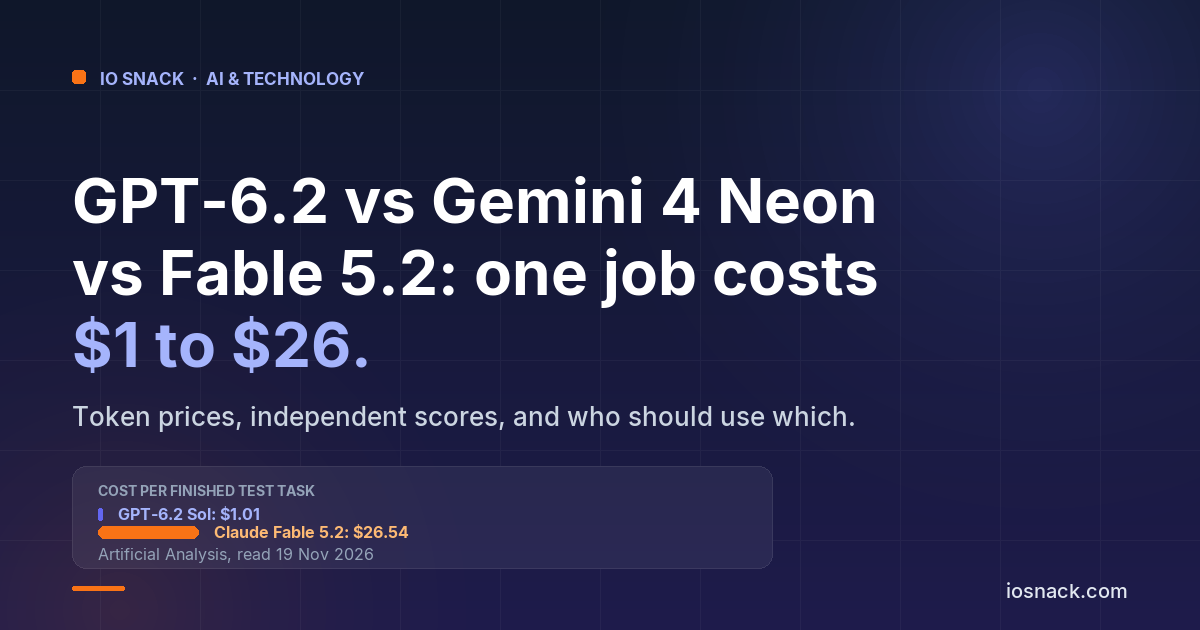
For most small and mid-sized businesses, Qwen4-Max is not the model to switch to this month. If you want the most work per dollar, GPT-6.2 Sol and GPT-6.1 Terra finish the independent test for about a third of the cost and score higher. If you want a free tier and Google's tools, Gemini 4 Hydrogen scores 54 at almost the same cost per task. If you only need simple, high-volume work, DeepSeek V4.1 Flash is far cheaper. We compared the premium end in GPT-6.2 vs Gemini 4 Neon vs Claude Fable 5.2.
Qwen4-Max earns a place on the shortlist for background jobs with very long inputs, video input, or as a cheap-to-add fallback supplier. Whatever you pick, run ten of your own real jobs through it and compare the bill per finished job, not the price per token.
That is the rule we follow when choosing models for our own products. If you would rather have a customer-facing assistant where the AI engine is chosen and monitored for you, with automatic failover to a backup engine, look at the IO Snack AI Chat Assistant, or tell us about your use case on our contact page.