Google made Gemini 4 Hydrogen generally available on 12 November. It is the cheap, everyday member of the Gemini 4 family: $1.50 per million input tokens and $7.50 per million output tokens, with a free tier, and no price rise scheduled. The independent test from Artificial Analysis scores it 54, which is 23 points above Gemini 3.8 Flash, the model Google tells developers to move off, and puts one finished test task at $3.16 against $7.77 for 3.8 Flash. That means Hydrogen costs twice as much per token and less than half as much per job. This article covers what Google released, what the independent numbers say, how Hydrogen compares with Carbon and Argon, and who should switch.
What Google released on 12 November
The facts below come from Google's own changelog, pricing page and model pages, read on 13 November.
- Model id.
gemini-4-hydrogen, a stable version, on both the free and paid tiers of the Gemini API and in Google AI Studio. - What it is for. Google positions it for everyday coding and agentic work, with the emphasis on speed and efficiency. It is also the default model for Google's Antigravity managed agent.
- Size. A context window of 1,048,576 tokens, shared by your input, the model's hidden thinking and its answer. Normal replies stop at 65,536 tokens; background mode allows up to a million tokens minus your input.
- What it takes in. Text, images, audio, video and PDFs. It outputs text only: no image or audio generation, and no Live API.
- What it does. Function calling, structured outputs, code execution, computer use, file search, URL context, and Google Search and Maps grounding.
The price: $1.50 in, $7.50 out, and it stays there
Everything below is per million tokens from Google's pricing page, and thinking tokens are billed as output.
| Tier | Input | Output | Cached input |
|---|---|---|---|
| Standard | $1.50 | $7.50 | $0.075 |
| Batch or Flex | $0.75 | $3.75 | $0.0375 |
| Priority | $2.70 | $13.50 | $0.135 |
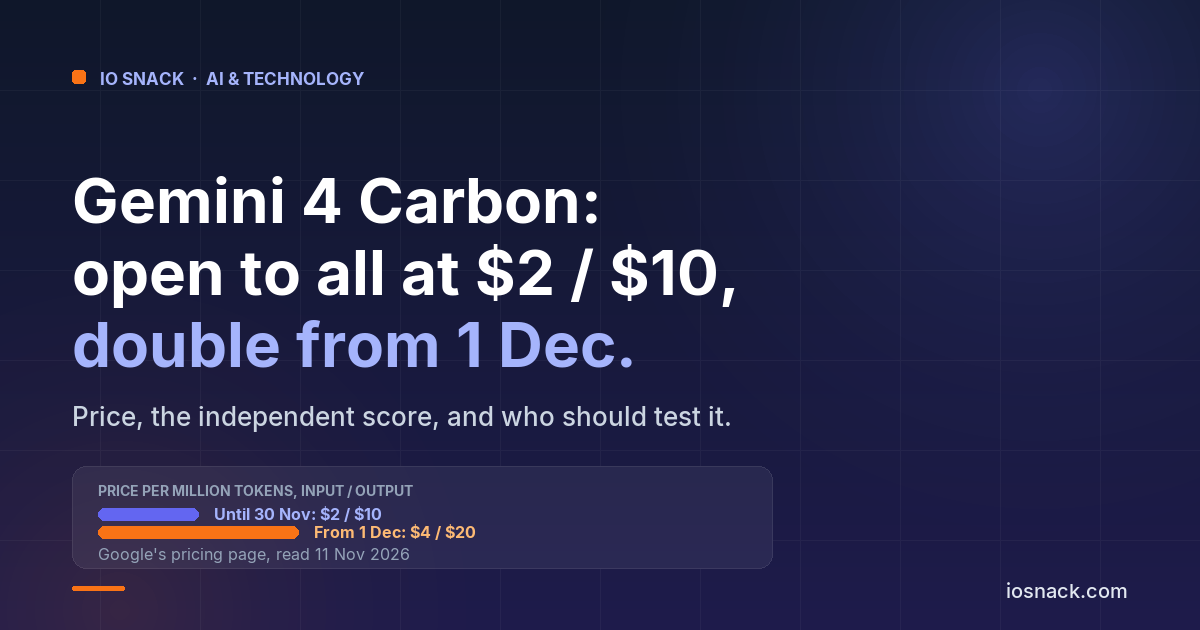
Two details help. The price is flat across the whole 1M-token window, so a very long prompt does not move you into a dearer band. And unlike its bigger siblings, the page lists no scheduled price change for Hydrogen. Gemini 4 Carbon and Argon double on 1 December, as we explained in our Carbon article.
A worked example, with our assumptions
Say a job reads a document and writes a short answer: 20,000 tokens in, 2,000 out. Those counts are our assumption, and they ignore thinking tokens, which are billed as output and will add to the total.
- Standard: $0.03 for input plus $0.015 for output, about $0.045 a job, or $45 per 1,000 jobs.
- Batch: half of that, about $22.50 per 1,000 jobs, if the work can wait.
What the independent test says: 54 points, $3.16 a task
Google's pages give no benchmark table, so the independent one carries this article. We read the Artificial Analysis page for each model on 13 November, all on the same Intelligence Index version (5.0.1). Hydrogen was tested at its highest thinking setting, xhigh; the others at their highest settings too.
| Model | Index score | Cost per task | Output tokens used |
|---|---|---|---|
| Claude Fable 5.2 | 65 | $26.54 | 275M |
| Gemini 4 Carbon (High) | 60 | $5.48 | 205M |
| Gemini 4 Hydrogen (xhigh) | 54 | $3.16 | 304M |
| Gemini 4 Argon (High) | 50 | $4.97 | 113M |
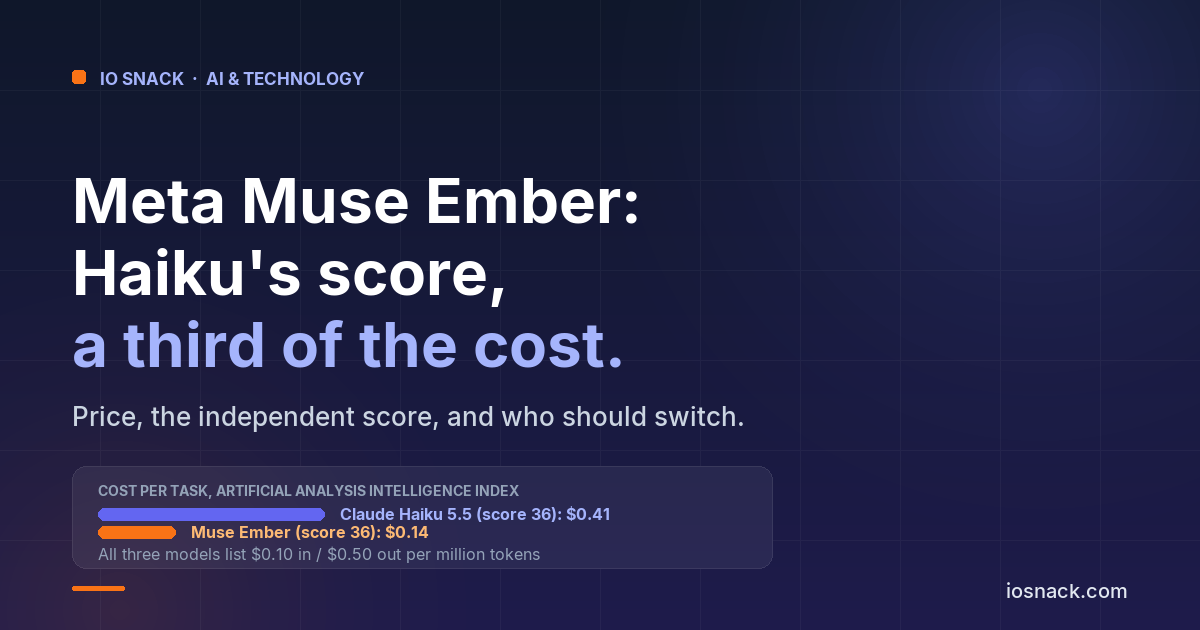
| Claude Haiku 5.5 (Max) | 36 | $0.41 | 298M |
| Gemini 3.8 Flash (High) | 31 | $7.77 | 126M |
Artificial Analysis ranks Hydrogen 16th of 78 models on intelligence. The median model scores 41, so 54 is well above the middle. A finished task takes 13.7 minutes against a median of 13.0, and the wait for the first answer token averages about 41 seconds. Output speed is 188 tokens a second.
Price per token is the wrong number to compare. Hydrogen costs twice what Gemini 3.8 Flash costs per token and less than half per finished job.
The arithmetic, from the page figures above: $3.16 against $7.77 is about 59% less per task, with 23 more points. Hydrogen used 304 million output tokens on the test against 126 million for 3.8 Flash, about 2.4 times as many, and still came out cheaper per task. We cannot see inside either model, so why the totals fall out that way is our reading, not a fact on the page.
Hydrogen against Carbon and Argon
The three Gemini 4 models are easy to confuse, so here is the short version.
- Carbon is the strongest: 60 points. It costs $5.48 a task on Artificial Analysis today, and Google's list price doubles on 1 December. Hydrogen is six points lower and about 42% cheaper per task ($3.16 against $5.48).
- Argon scores 50, four points below Hydrogen, and costs $4.97 a task, about 57% more than Hydrogen. On these numbers we see little reason to pick Argon over Hydrogen for a new project.
- Hydrogen is the only one of the three with a free tier. Carbon and Argon are paid only.
One caution. Artificial Analysis changes its published figures from day to day: Carbon showed $7.76 a task when we wrote that article and shows $5.48 now. Re-check the page before you build a budget on any single figure here.
Against the cheap Claude, and the premium one
Hydrogen is not the cheapest model that exists. Claude Haiku 5.5 scores 36 and costs $0.41 a task. Meta's Muse Ember, which we covered in our Muse Ember article, costs even less. If your job is classification, simple extraction or short replies, a model at 36 may be enough, and it is roughly eight times cheaper per task than Hydrogen ($0.41 against $3.16).
The question is where your work sits. A 54 suits multi-step coding, long PDFs and answers drawn from several documents; a 36 is a riskier bet there. Our advice from the cheapest-model article still holds: test your own jobs on the cheap model first, and move up only when it fails.
At the other end, Claude Fable 5.2 scores 11 points higher (65) but costs about 8.4 times as much per task ($26.54 against $3.16). Unless the extra points change a result you are paid for, that is a lot of money. We covered it in our Fable 5.2 article.
Switching from Gemini 3.8 Flash: what to change
Google's migration notes are short, and a few items will break a naive swap.
- Change the model id to
gemini-4-hydrogen. - Check the thinking level. The default is now high, not medium. Levels are low, medium, high and xhigh. Google says to reserve xhigh for hard multi-step problems. The value "minimal" is rejected with an error.
- Raise low output caps. The cap includes thinking tokens, so an old 8,192 limit can cut answers off. Google suggests 65,536.
- Remove explicit caching. It is not supported. Implicit caching applies automatically to prompts of 4,096 tokens or more, with a 95% discount on a hit.
- Drop temperature, top-p and top-k. The server ignores them.
- Declare your tools. Prompting for raw-text JSON tool calls with no declared tools can return a MALFORMED_FUNCTION_CALL error.
The practical advice: run your real jobs at low first, then raise the level only for those that fail. The Artificial Analysis cost of $3.16 is for xhigh, so it is a ceiling for hard work, not a typical job.
The free tier has a catch
Google's pricing page says Hydrogen is free of charge on the standard tier, rate-limited, and also says that free-tier content may be used to improve Google's products. For a hobby project that is fine. For anything with customer names, invoices, call recordings or staff data, it is not. Put business data through the paid tier only, and read Google's terms for what that tier promises. We have not read those terms for this article.
Who should switch, and what to do next
- You run Gemini 3.8 Flash in production. Test Hydrogen on a sample of real jobs this week. The independent numbers say better answers at a lower cost per job, but your own jobs are the test that counts.
- You were waiting for Carbon. Compare both on your hardest tasks. If Hydrogen is good enough, you skip the 1 December doubling entirely.
- You use a small model for simple tasks. Stay where you are unless quality is the problem.
- You handle private customer data. Use the paid tier, never the free one.
This is the same logic we use building our own products: pick the cheapest model that passes your test, and re-run the test whenever a new one arrives. If you want to see where AI fits your business, look at the AI Chat Assistant and IO Snack Accounts, or ask us at our contact page. For the rest of the family, read the Argon article.