Google's strongest reasoning model, Gemini 4 Carbon, opened to every paid developer on 10 November. It costs $2 per million input tokens and $10 per million output tokens, but only until 30 November. On 1 December Google's pricing page doubles both to $4 and $20. The independent test from Artificial Analysis scores Carbon 60 and puts one finished test task at $7.76, which is cheaper than Claude Opus 5.5 and under a third of the cost of Claude Fable 5.2. This article covers what Google released, what the independent numbers say, why the 1 December price matters more than the launch price, how Carbon compares with Gemini 4 Argon, and who should test it.
What Google released on 10 November
Carbon is not new. Google announced it on 28 October to a small group of cybersecurity partners, with no date for anyone else. The Gemini API changelog now lists it as generally available. The facts from Google's own pages, read on 11 November:
- Model id.
gemini-4-carbon, a stable version, on the paid tier of the Gemini API and in Google AI Studio. Google says plainly that it is not available on the free tier. - What it is for. Google calls it its strongest reasoning model, built for long agentic coding jobs, multimodal knowledge work across PDFs, spreadsheets and slides, scientific reasoning and cybersecurity.
- Size. A context window of 1,048,576 tokens, shared by your input, the model's hidden thinking and its answer. Normal replies stop at 65,536 tokens; with background mode switched on, output can run up to a million tokens minus your input.
- What it takes in. Text, images, audio, video and PDFs. It outputs text only.
- Where. The Gemini API, AI Studio and Google's Managed Agents (through its Antigravity agent). The pages we read do not mention Vertex AI or the Gemini app, so check those separately before you plan around them.
The price that matters is the one from 1 December
Google's pricing page lists two sets of numbers for Carbon. Everything below is per million tokens, and thinking tokens are billed as output.
| Tier | Input to 30 Nov | Output to 30 Nov | Input from 1 Dec | Output from 1 Dec |
|---|---|---|---|---|
| Standard | $2.00 | $10.00 | $4.00 | $20.00 |
| Batch or Flex | $1.00 | $5.00 | $2.00 | $10.00 |
| Priority | $3.60 | $18.00 | $7.20 | $36.00 |
| Cached input | $0.10 | $0.20 |
Every row doubles. Gemini 4 Argon, the cheaper sibling, has exactly the same prices in every tier on the same page, so the choice between the two is about quality and token use, not the price list.
Carbon at $2 and $10 is a launch offer, not a price. Plan your budget on the $4 and $20 that start on 1 December.
A worked example, with our assumptions
Say a job reads a long document and writes a short answer: 20,000 tokens in, 2,000 out. Those token counts are our assumption, and they ignore the thinking tokens Carbon adds, which are billed as output.
- Standard, until 30 November: $0.04 for input plus $0.02 for output, $0.06 a job, or $60 per 1,000 jobs.
- Standard, from 1 December: $0.08 plus $0.04, $0.12 a job, or $120 per 1,000.
- Batch, from 1 December: $0.04 plus $0.02, $0.06 a job, or $60 per 1,000. If a job can wait, the batch tier gives the November price back.
For comparison, Claude Opus 5.5 lists at the same $4 and $20, so from 1 December the sticker price of the two is identical. What separates them is how many tokens each one spends, which is the next section.
What the independent test says: 60 points, $7.76 a task
Google's own page gives no benchmark table, so the independent one carries this article. We read the Artificial Analysis page for each model on 11 November. All figures are for the highest reasoning setting, which is what Artificial Analysis tests.
| Model | Index score | Cost per task | Output tokens used | Minutes per task | Price in / out |
|---|---|---|---|---|---|
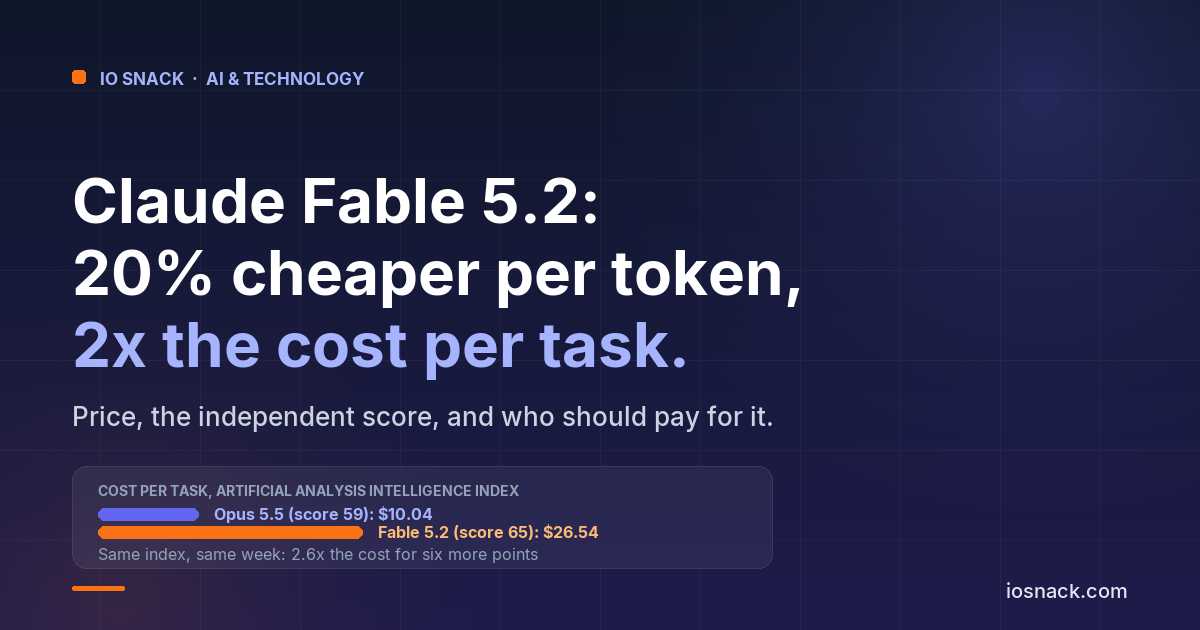
| Claude Fable 5.2 | 65 | $26.54 | 275M | 44.4 | $8 / $40 |
| Gemini 4 Carbon (High) | 60 | $7.76 | 205M | 24.9 | $4 / $20 |
| Claude Opus 5.5 | 59 | $10.04 | 218M | 24.7 | $4 / $20 |
| GPT-6 Astra | 57 | $6.24 | 54.3M | 23.0 | $10 / $50 |
| Gemini 4 Argon (High) | 50 | $9.95 | 113M | 28.6 | $4 / $20 |
Artificial Analysis ranks Carbon fourth of 74 models on intelligence. When Google announced it on 28 October it sat first at 59; Claude Fable 5.2 has since taken the top spot at 65. Carbon's page shows 205 million output tokens on the test against a median of 72.8 million for comparable models, and 24.9 minutes per task against a median of 12.7. The wait for the first answer token averages about 68 seconds. A model that thinks this much is for work you hand off, not for a live chat.
Two readings of the table are worth stating. Carbon scores one point above Opus 5.5 and costs about 23% less per task, from the same $4 and $20 price list. And Fable 5.2 beats Carbon by five points but costs about 3.4 times as much per task ($26.54 against $7.76). We work those ratios out from the page figures above.
One caution on the price. Artificial Analysis lists Carbon at $4 and $20, which are the December prices, so we read its $7.76 as the cost at the December price. At the November introductory price the same task should cost about half, roughly $3.88. That halving is our own arithmetic, not a figure on either page.
Carbon against Argon: the same price, a different bill
Google's models page says Argon is the more efficient of the two, with faster responses and lower token spend per turn. The independent numbers agree on the token count: Argon used 113 million output tokens on the test, Carbon 205 million, about 1.8 times as many. Yet Carbon's cost per task is lower, $7.76 against $9.95, and its score is ten points higher, 60 against 50. We cannot explain that gap from the pages alone. Artificial Analysis revised its Intelligence Index to a new version one day before Carbon's announcement, and it warns that scores from the new version are not directly comparable with earlier ones, so do not set these numbers against the Argon figures in our earlier Argon article.
The practical point is that token price alone does not tell you which one is cheaper for your job. We made the same argument for Claude in our Fable 5.2 article: the bill depends on how long the model chooses to think.
Thinking level is your cost dial
Carbon has three thinking levels: low, medium (the default) and high. Google describes low as the fewest tokens and lowest delay, for simpler or cost-sensitive work, and high as the most tokens and the slowest first answer, for hard maths, science and difficult code. Google's own advice is to run your tests at all three and keep the lowest level that meets your quality bar. The Artificial Analysis result is for high, so $7.76 is a ceiling for hard work, not a typical job.
- Start at low. Run your real jobs there first. Move up only for the ones that fail.
- Raise the output limit. The setting for maximum output includes thinking tokens. Google recommends at least 32,768 for existing apps, or answers can be cut off.
- Expect long waits. For Gemini 3 and earlier code, Google's migration notes ask for HTTP timeouts of at least 15 minutes.
- Drop your sampling settings. Temperature, top-p and top-k are ignored by this model, so tuning them does nothing.
- Caching is automatic only. Repeated prompts of 4,096 tokens or more are cached by default, and Google says a cache hit gets a 95% discount. Explicit caching is not supported.
Moving from Argon is easy: Google says to change the model id, with no change to the request format, but to check your timeouts and output limits because Carbon thinks longer.
Who should test Carbon, and who should not
- Hard analysis and coding that you can queue: yes, test it this month. Long documents, spreadsheets with many sheets, difficult code. The batch tier at November prices is a cheap way to find out.
- Teams currently paying for Opus 5.5: run a side-by-side. One more index point at a lower cost per task is a small edge, but it is a free one to check. Our guide to cost per task shows the method.
- People who need the single best answer: look at Fable 5.2. Five more points on the independent test, at 3.4 times the cost per task. That is only worth it where one wrong answer costs more than the difference.
- Customer-facing chat and voice: no. A first token that takes about a minute is the wrong shape for a live conversation. Use a small, fast model.
- Free-tier users: you cannot. Carbon is paid only.
Your next step: test before 30 November, budget for 1 December
Pick 50 real jobs and run them at low, medium and high thinking on Carbon, and at the same settings on the model you use now. Write down quality and cost for each. Do it before the end of the month, while the introductory price makes the test cheap, and then multiply the result by two to see your real December cost.
If you would rather use AI than manage models, that is what our products are for. IO Snack Accounts uses AI to categorise entries and flag anomalies as you post them, and the AI Chat Assistant answers customer questions on your website. If you are weighing a bigger project and want a second opinion on which model fits it, talk to us.